Nepal Labour Force Survey 2017-2018, Third Round
Nepal, 2017 - 2018
Central Bureau of Statistics
Created on July 05, 2019
Last modified July 05, 2019
Page views 93571
Download 8518
Documentation in PDF
Metadata
DDI/XML
JSON
Identification
Survey ID Number
NPL-CBS-NLFS-2018-v01
Title
Nepal Labour Force Survey 2017-2018, Third Round
Subtitle
Third Round
Translated Title
Nepal Sramsakti Sarvekshan 2074/75
Country
| Name | Country code |
|---|---|
| Nepal | NPL |
Study type
Labor Force Survey [hh/lfs]
Series Information
The Nepal Labour Force Survey 2018 (NLFS III) is the third round of labour force surveys in Nepal. The first and second of this kind was conducted in 1998-1999 and 2008 respectively.
Abstract
The Nepal Labour Force Survey (NLFS III) was conducted by the Central Bureau of Statistics in 2017-2018. This was the third Labour Force Survey and followed NLFS I in 1998/99 and NLFS II in 2008. This report presents the results of the 2017-2018 survey. However, due to changes in the standards after the 19th International Conference of Labour Statisticians, results of NLFS III may not be comparable to the previous surveys. The main objective of the survey is, where possible, to analyse the patterns of key labour market outcomes and trends.
The survey is a household-based sample survey designed to collect the data on various forms of work, based on which the total labour force in the country is estimated. This survey aims to collect information on employment, unemployment, underemployment and labour-underutilization along with a set of special questions on housing, agricultural land ownership and include several modules, such as own-use production of goods and provision of services, absentees, and volunteer work.
The survey is a household-based sample survey designed to collect the data on various forms of work, based on which the total labour force in the country is estimated. This survey aims to collect information on employment, unemployment, underemployment and labour-underutilization along with a set of special questions on housing, agricultural land ownership and include several modules, such as own-use production of goods and provision of services, absentees, and volunteer work.
Kind of Data
Sample survey data [ssd]
Unit of Analysis
Household, Individual
Version
Version Description
v01: Final data for internal use only.
Version Date
2019-07-03
Scope
Notes
The main objective of the Nepal Labour Force Survey 2017-2018 (NLFS III) was to update labour force statistics. The objective was extended to collect information on other forms work other than employment, which included production of goods and services for own final use and volunteer work . The new concepts and definitions (recommendation of 19th ICLS) used in NLFS III set benchmark statistics on employment, unemployment and underemployment. Such information plays key role in assessing the impact of various government policies and programs planned for employment generation. Likewise, the results from the survey do provide information required for skill development, for managing the flow of migrant workers, for improving the status of women and children, and for assessing the role and importance of the informal sector.
Keywords
| Keyword |
|---|
| Labour |
| Labour Force |
| Labour Force Survey |
| Nepal Labour Force Survey |
Coverage
Geographic Coverage
National Coverage, 14 domains (7 Provinces and by urban rural areas).
Universe
As in the NLFS I and NLFS II, the survey covered whole country. Following the same concept and definition of household as used in population census, i.e. the usual place of residence, all residents of the country including foreign nationals were considered eligible for the survey but households of diplomatic missions and institutional households such as school, hostels, prisons, army camps and hospitals were excluded. People living for six months or more away from the households were not considered eligible and hence were excluded from the survey.
Producers and sponsors
Primary investigators
| Name | Affiliation |
|---|---|
| Central Bureau of Statistics | National Planning Commission, Government of Nepal |
Funding Agency/Sponsor
| Name | Abbreviation |
|---|---|
| Government of Nepal | GoN |
| International Labour Organization | ILO |
Sampling
Sampling Procedure
A total sample of 18,000 households was selected for this survey, 10,500 households from urban area and 7,500 households from rural area. The sample design involved a two-stage probability proportional to size (PPS) selection process. First, wards were selected with PPS, where the number of households at the time of the census provided the measure of size. Then within the selected primary sampling unit (PSU), consisting of the ward or in some cases a sub-ward or an amalgamation of small wards, all households were to be listed in the field and 20 households selected by systematic sampling.
Annex II of the NLFS-III report provides a detailed description of the sample design and its implementation.
Annex II of the NLFS-III report provides a detailed description of the sample design and its implementation.
Weighting
Given the final weight adjusted for population projections, the Horwitz-Thompson estimator is used. Oftentimes, variance is estimated through linear approximation or through resampling methods. To estimate proportions, the total in equation of variance is simply divided by the total population count for the segment of interest. For example, to estimate employment rate among females in any domain, equation of variance is used to estimate the total number of employed females in that domain. Then the total number of female in the labor force is used as the denominator to compute the employment rate.
Data Collection
Dates of Data Collection
| Start | End | Cycle |
|---|---|---|
| 2017-07-16 | 2018-06-15 | Three Cycle |
Time periods
| Start date | End date | Cycle |
|---|---|---|
| 2017-07-16 | 2017-09-15 | Rainy |
| 2017-09-16 | 2017-12-15 | Winter |
| 2017-12-16 | 2018-05-15 | Dry |
| 2018-05-16 | 2018-06-15 | Rainy |
Data Collection Mode
Face-to-face [f2f]
Supervision
Day to day control of each team was in the hands of the team leader, who was a member of the team, but additional supervisory visits were made by the staff from the CBS and the NPC. These visits were particularly important in the early stages of the field period, when interviewers were still not very familiar with the questionnaire. Thus, the extensive field supervisions both from the centre (CBS) and from the districts (SOs) were carried out during the survey period.
Data Collection Notes
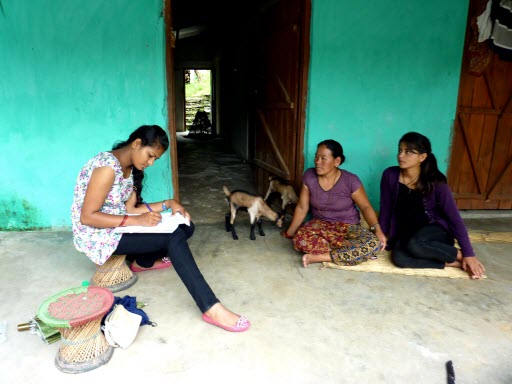
Twenty-four teams were formed to collect data from different parts of the country. Each team composed of one team leader, one supervisor/enumerator from statistics office and two members hired with the support from ILO. Each team was assigned a group of districts to carry out the interviews. Work load was assigned keeping in mind the state of urbanization, remoteness of the area, access of road and number of households in the PSU. Each team, on an average was supposed to cover 38 PSUs. Knowledge on local language and cultural familiarities were considered in deputation of the team.
Master trainers who belonged to the Household Survey Section and officials involved in NLFS I or NLFS II of the Central Bureau of Statistics were responsible for carrying out the training for the surveyors. A training for officials from the CBS was carried out to enhance central supervision and a separate training was conducted for the heads of statistics offices so that they would be able to provide adequate supervision and support to the field staff wherever necessary. This was then followed by an 18-day long training course for supervisors and enumerators together. Because of the large number of field staff (72) involved, three separate training groups were run simultaneously. A day-long field visit for the trainees was conducted which was very useful to know the techniques to deal with the respondents especially for those surveyors who were new for the survey.
Master trainers who belonged to the Household Survey Section and officials involved in NLFS I or NLFS II of the Central Bureau of Statistics were responsible for carrying out the training for the surveyors. A training for officials from the CBS was carried out to enhance central supervision and a separate training was conducted for the heads of statistics offices so that they would be able to provide adequate supervision and support to the field staff wherever necessary. This was then followed by an 18-day long training course for supervisors and enumerators together. Because of the large number of field staff (72) involved, three separate training groups were run simultaneously. A day-long field visit for the trainees was conducted which was very useful to know the techniques to deal with the respondents especially for those surveyors who were new for the survey.
Data Collectors
| Name | Abbreviation | Affiliation |
|---|---|---|
| Central Bureau of Statistics | CBS | National Planning Commission, Government of Nepal |
Questionnaires
Questionnaires
The NLFS II questionnaire was developed on the basis of an ILO recommendation including core and supplementary modules comprising 130 questions in eight sections. This provided guidelines for developing the NLFS III questionnaire. The NLFS III questionnaire was substantially expanded to 168 questions in fourteen sections. The flow of questionnaire structure was organized in such a way that respondents' burden in the survey can be minimized.
Data Processing
Data Editing
NLFS III is the first paperless large-scale national household survey conducted by the CBS using Tablet computers. Household listing as well as filling-up of main questionnaires was done through Tablets. A central database server was set up in the CBS to manage database of the survey. Enumerators had been allowed to send collected information in the central server after the completion of filling questionnaires and thoroughly reviewing all the information captured in the tablet. Data processing system was centralized in this survey. In this survey, household survey team had more advantage of accessing the data immediately. If any inconsistences were found in data it was informed immediately to the field team so that field staff could confirm the issues before leaving the PSU.
Other Processing
It was advantage of this survey that the burden of data entry was decreased due to the use of tablets for data collection. As usual, the CSPro (Census and Survey Processing) software was used for data management in the NLFS III. Household Survey Section had previous experience of using statistical software (STATA) for preparing output tables from censuses and surveys. So, the required tables for NLFS III were produced using STATA.
Access policy
Access authority
| Name | Affiliation | URL | |
|---|---|---|---|
| Director General | Central Bureau of Statistics, Nepal | info@cbs.gov.np | cbs.gov.np |
Contacts
| Name | Affiliation | URL | |
|---|---|---|---|
| Director of Publication, Dissemination and Library Section | CBS | archive@cbs.gov.np | cbs.gov.np |
Confidentiality
Confidentiality of the respondents is guaranteed by article 8 of Statistics Act 1958.
Restriction on publication of information and details
Any information or details relating to any person, family, firm or company, which have been supplied, obtained or prepared pursuant to Section 3 or Section 4 or Section 5 or Section 6 or Section 7 or any part of such information or details, shall not be disclosed or published directly except to the Director General or to any other officers of the Bureau without the written permission of the person or of his or her authorized representative supplying such information or details.
Access conditions
The dataset has been anonymized and is available for public use.
Citation requirements
Central Bureau of Statistics (CBS), Nepal Labour Force Survey 2017-2018.
Disclaimer and copyrights
Disclaimer
The Central Bureau of Statistics, Nepal bears no responsibility for any outcomes or for interpretations or inferences arising from the use of the data, or use of the information provided on the study.
Copyright
(c) 2018, Central Bureau of Statistics, Nepal
Metadata production
DDI Document ID
DDI-NPL-CBS-NLFS-2018-v01
Producers
| Name | Abbreviation | Affiliation | Role |
|---|---|---|---|
| Central Bureau of Statistics | CBS | National Planning Commission, Government of Nepal | Documentation of the Study |
Date of Metadata Production
2019-07-03
DDI Document version
v1 : anonymous dataset for public distribution (under certain legal conditions)