Nepal Labour Force Survey 2008, Second Round
Nepal, 2008
Central Bureau of Statistics
Created on September 01, 2016
Last modified September 01, 2016
Page views 999281
Download 751330
Documentation in PDF
Metadata
DDI/XML
JSON
Identification
Survey ID Number
NPL-CBS-NLFS-2008-v2
Title
Nepal Labour Force Survey 2008, Second Round
Subtitle
Second Round
Translated Title
Nepal Shramshakti Sarwekshan Doshro
Country
| Name | Country code |
|---|---|
| Nepal | NPL |
Study type
Labor Force Survey [hh/lfs]
Series Information
The Nepal Labour Force Survey 2008 (NLFS II) is the second round of labour force surveys in Nepal. The first of this kind was conducted in 1998-99. The household survey section of Central Bureau of Statistics is responsible for conducting labour force surveys in Nepal.
Abstract
Nepal Labour Force Survey 2008 is the second attempt in conducting the labour force survey in Nepal. It updates various indicators of labour force statistics obtained from the Nepal Labour Force Survey 1998/99, which was the first of its kind in Nepal. Both surveys provide essential statistics for monitoring employment and labour market developments in Nepal. The surveys of this kind have tried to address the various labour related issues of the country as well.
The concepts of employment and labour underutilisation have been measured more carefully and more precisely in this survey than in the Nepal Living Standards Surveys I & II (1995/1996 and 2003/04). Hence the users should be careful while comparing the labour force statistics with NLSS I & II.
The survey provides a number of valuable indicators to monitor progress towards achieving the Millennium Development Goals which were established by the United Nations Millennium Summit in 2000.
This survey provided new estimates of informal employment and labour underutilisation that are based on the new concept of labour underutilisation which was recently submitted to the ILO's International Conference of Labour Statisticians, (Geneva, November-December 2008).
Alike the first labour force survey, this survey has also given special attention to measure the activities of women and children and hence provides improved estimates of employment and labour underutilisation among them.
The concepts of employment and labour underutilisation have been measured more carefully and more precisely in this survey than in the Nepal Living Standards Surveys I & II (1995/1996 and 2003/04). Hence the users should be careful while comparing the labour force statistics with NLSS I & II.
The survey provides a number of valuable indicators to monitor progress towards achieving the Millennium Development Goals which were established by the United Nations Millennium Summit in 2000.
This survey provided new estimates of informal employment and labour underutilisation that are based on the new concept of labour underutilisation which was recently submitted to the ILO's International Conference of Labour Statisticians, (Geneva, November-December 2008).
Alike the first labour force survey, this survey has also given special attention to measure the activities of women and children and hence provides improved estimates of employment and labour underutilisation among them.
Kind of Data
Sample survey data [ssd]
Unit of Analysis
individual, household
Version
Version Description
v2 : Edited, anonymous dataset for public distribution (under certain legal conditions)
Version Date
2009-07
Scope
Notes
The scope of the Nepal Labour Force Survey 2008 includes:
HOUSEHOLD AND HOUSING CHARACTERISTICS: Occupancy status, Access to drinking water supply, Fuel used for cooking, Main source used for lighting, Toilet facilities available, Communication facilities available, Agriculture holding.
DEMOGRAPHIC CHARACTERISTICS: Household distribution, Household composition, Household heads by sex, Age and sex distribution.
EDUCATION AND TRAINING: Educational status, Literacy rates, Vocational training.
ECONOMIC ACTIVITY: Employment, Unemployment, Underemployment, Current and usual status of economic involvement.
INFORMAL SECTOR AND EMPLOYMENT: Characteristics of the informal sector, Informal employment - Characteristics of non-agricultural informal employment.
NON-ECONOMIC ACTIVITIES: Time spent on non-economic activities.
MIGRATION AND ABSENTEES: Status of migrants, Age and sex distribution, Origin of migration, Reason for migration, Absentees - by place of current residence, Activity status of absentees aged 5 years and above.
REMITTANCES: Households receiving remittance, Source of remittance.
HOUSEHOLD AND HOUSING CHARACTERISTICS: Occupancy status, Access to drinking water supply, Fuel used for cooking, Main source used for lighting, Toilet facilities available, Communication facilities available, Agriculture holding.
DEMOGRAPHIC CHARACTERISTICS: Household distribution, Household composition, Household heads by sex, Age and sex distribution.
EDUCATION AND TRAINING: Educational status, Literacy rates, Vocational training.
ECONOMIC ACTIVITY: Employment, Unemployment, Underemployment, Current and usual status of economic involvement.
INFORMAL SECTOR AND EMPLOYMENT: Characteristics of the informal sector, Informal employment - Characteristics of non-agricultural informal employment.
NON-ECONOMIC ACTIVITIES: Time spent on non-economic activities.
MIGRATION AND ABSENTEES: Status of migrants, Age and sex distribution, Origin of migration, Reason for migration, Absentees - by place of current residence, Activity status of absentees aged 5 years and above.
REMITTANCES: Households receiving remittance, Source of remittance.
Topics
| Topic | Vocabulary | URI |
|---|---|---|
| LABOUR AND EMPLOYMENT [3] | CESSDA | http://www.nesstar.org/rdf/common |
Keywords
| Keyword |
|---|
| Labour Force Participation Rate |
| Employment-to-Population Ratio |
Coverage
Geographic Coverage
National Rural/ Urban areas Development region 6 strata: Mountain, Kathmandu Valley (Urban), Other hills (Urban), Rural hills, Urban Terai, Rural Terai
Geographic Unit
Development Region
Sample Stratum
Sample Stratum
Universe
The survey covered entire country and no geographical areas were excluded. Similarly, all permanent residents of the country including foreign nationals were considered eligible for inclusion in the survey, but households of diplomatic missions and institutional households such as school hostels, prisons, army camps and hospitals were excluded. The homeless and those people living for six months or more away from the households were not considered eligible and hence were excluded from the survey.
Producers and sponsors
Primary investigators
| Name | Affiliation |
|---|---|
| Central Bureau of Statistics | National Planning Commission Secretariat, Government of Nepal |
Producers
| Name | Role |
|---|---|
| International Labour Organization | Technical support in report preparation |
Funding Agency/Sponsor
| Name | Abbreviation | Role |
|---|---|---|
| Government of Nepal | GoN | Partial funding |
| International Labour Organization | ILO | Partial funding |
| United Nations Development Programme | UNDP | Partial funding |
Sampling
Sampling Procedure
The sample size for the NLFS II 2008 is 16,000 households. Half of the sample was allocated to urban areas, and half to rural areas, because of the importance of getting good estimates of economic activity for each of these areas. Urban areas are stratified into three strata as Urban Kathmandu Valley, Other Urban Hills and Urban Tarai, and rural areas are stratified into Rural Mountains, Rural Hills and Rural Tarai respectively. The sample size of 400 PSUs in each urban and rural area was proportionately distributed within their respective strata. In both urban and rural areas the sample was spread out evenly over the three main seasons of the year (rainy season, winter season, and dry season), so as to cover seasonal variations in economic activity. The sample was not large enough to allow separate analysis of the results for each district, but the estimates can be obtained for various groupings of the 15 eco-development regions (five development regions covering three ecological belts).
The primary sampling unit is the ward and sub ward. Within each stratum, wards have been selected on the basis of their size; the likelihood that a ward is selected is proportional to the number of households living in that ward. Within each ward, 20 households have been selected and interviewed. In this way, data have been collected from 800 wards around the country; 400 of them in urban areas and 400 in rural areas. This means that in each season of the year at least 133 urban wards and 133 rural wards have been visited.
Annex A of the NLFS II report provides a detailed description of the sample design and its implementation.
The primary sampling unit is the ward and sub ward. Within each stratum, wards have been selected on the basis of their size; the likelihood that a ward is selected is proportional to the number of households living in that ward. Within each ward, 20 households have been selected and interviewed. In this way, data have been collected from 800 wards around the country; 400 of them in urban areas and 400 in rural areas. This means that in each season of the year at least 133 urban wards and 133 rural wards have been visited.
Annex A of the NLFS II report provides a detailed description of the sample design and its implementation.
Response Rate
Out of the 16000 households selected for the survey, only 24 could not be enumerated yielding a response rate of 99.9985 percent. The difference resulting from this non response has been adjusted while designing the weights for the sample.
Weighting
Each PSU has been assigned a weight depending on the number of households it contain. Every households within a PSU are given the PSU weights for raising up purposes.
Because of the way the sample has been designed, it is possible to use all the information arising from the survey to estimate the total number of households and total household population of Nepal. Indeed, because the sample for each season is fully representative, this exercise can be done separately for each season.
The overall raising factor for the survey is 315. This means that, on average, the NLFS II conducted interviews with 1 in 315 of the population of all age. Because of the importance of the urban sector and its relatively small size and greater heterogeneity, an interviewing rate of 1 in 103 was used in the Kathmandu urban area, 1 in 103 in Other Hill Urban and 1 in 100 in Terai Urban compared with 1 in 482 in the rural sector of Mountain area, 1 in 473 in Rural Hill and 1 in 535 in Rural Terai.
Because of the way the sample has been designed, it is possible to use all the information arising from the survey to estimate the total number of households and total household population of Nepal. Indeed, because the sample for each season is fully representative, this exercise can be done separately for each season.
The overall raising factor for the survey is 315. This means that, on average, the NLFS II conducted interviews with 1 in 315 of the population of all age. Because of the importance of the urban sector and its relatively small size and greater heterogeneity, an interviewing rate of 1 in 103 was used in the Kathmandu urban area, 1 in 103 in Other Hill Urban and 1 in 100 in Terai Urban compared with 1 in 482 in the rural sector of Mountain area, 1 in 473 in Rural Hill and 1 in 535 in Rural Terai.
Data Collection
Dates of Data Collection
| Start | End | Cycle |
|---|---|---|
| 2008-01 | 2008-05 | Dry season |
| 2008-05 | 2008-09 | Wet season |
| 2008-09 | 2008-12 | Winter season |
Data Collection Mode
Face-to-face [f2f]
Supervision
Altogether 20 field teams were formed to undertake fieldwork in different parts of the country. Each team was assigned particular areas to carry out the interviews. The field work assigned to teams was on the basis of geographical area and the purview of the Branch Statistical Offices (BSOs). Other factors considered were based on the workload and travelling time required. Each team, on an average was supposed to cover 40 PSUs. Manpower composition in each team consisted of a supervisor and three interviewers. All the field staffs were selected from the BSOs. A majority of them were males with only a few female staff.
Day to day control of each team was in the hands of the supervisor who was a member of the team, but additional supervisory visits were made by staff from the headquarters of the Central Bureau of Statistics and the National Planning Commission Secretariat. These visits were particularly important in the early stages of the field period, when interviewers were still not very familiar with the questionnaire. Thus the extensive field supervision both from the centre and from the districts (BSOs) was carried out during the survey period. Moreover the central supervision was carried out not only by the core team member of household survey section but also by the Director General and Deputy Director General of the Bureau. In addition, district level supervision was also made by the statistical officers of the BSOs.
Day to day control of each team was in the hands of the supervisor who was a member of the team, but additional supervisory visits were made by staff from the headquarters of the Central Bureau of Statistics and the National Planning Commission Secretariat. These visits were particularly important in the early stages of the field period, when interviewers were still not very familiar with the questionnaire. Thus the extensive field supervision both from the centre and from the districts (BSOs) was carried out during the survey period. Moreover the central supervision was carried out not only by the core team member of household survey section but also by the Director General and Deputy Director General of the Bureau. In addition, district level supervision was also made by the statistical officers of the BSOs.
Data Collection Notes
The survey was spread over a complete 12 months period from January 2008 until December 2008, splitting annual sample into three sub-groups for three seasons, namely, dry, rainy and winter seasons. Each sub-group was representing four months in the Nepalese calendar. Data collection actually started on 25 December 2007 but households enumerated in these first few days of the survey were classified as part of the sample for the “Dry” season.
Fieldwork continued throughout the survey year, but was curtailed for one month from mid-April 2008 because of an impending constitution assembly election. The delay in data collection was recovered within the following two months, but there may be some effect on sample allocation as between the "Dry" season and "Rainy" season as a result.
Although extensive cartographic work had already been done in connection with the NLSS-II, the staff of NLFS-II carried out further cartographic work where it was considered necessary, so as to establish clear boundaries for the selected areas.
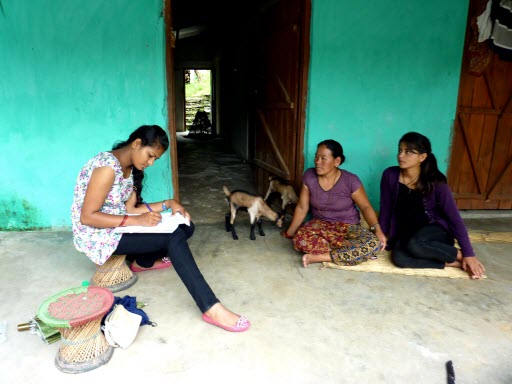
In many rural areas interviewing of young women by young men posed difficulties for cultural reasons. Consequently, data often had to be collected through proxies possibly affecting data quality to some extent. There were two teams assigned for Kathmandu due to the larger sample in this city.
Training
Four master trainers who belonged to the Household Survey Section of the Central Bureau of Statistics were responsible for carrying out the training programme for the survey. In the beginning, a separate training programme was launched for the BSO officers so that they would be able to provide adequate supervision and support to the field staff wherever necessary. This was then followed by a three-week training course for supervisors and enumerators together at the Staff College in Kathmandu. Because of the large number of field staffs involved (22 supervisors plus 65 enumerators, allowing for some reserves), three separate training groups were run simultaneously. Two days were spent in discussion of the interviewers' duties and general issues relating to the fieldwork, and a further three days in clarifying the key concepts used in labour force surveys. Only after that did the classes move into detailed discussion of the questionnaire. Towards the end of the training class, all field staff spent a day in urban and rural areas, with each person being required to interview at least four households. The final day was spent on a debriefing of this fieldwork exercise.
A short questionnaire was administered towards the end of the training, to evaluate the quality of the training courses and find out which aspects were still unclear, and the results were used on the final day to re-emphasize certain points.
The Nepalese terrain has always provided challenges for data gathering because many areas cannot be reached by road. In addition, for this NLFS-I survey, there was a further challenge for field operations in the Terai due to social and political disruptions. As a result, three teams were formulated in such a way as to be representative of various communities, and to be familiar with local dialects. These teams were assigned to undertake interviews in sensitive districts of the Terai.
In designing the survey, there was a concern to keep interviews to a manageable length. There was an obvious desire not to impose unnecessary burden on household members, who were giving freely their time in responding to the questions asked. There was also the consideration that the interviews within each household should not take too long, so that interviewers could complete their work load of 20 households and move on to the next PSU. Despite the increase in the number of questions when compared with the NLFS-I, the interviews with each selected person normally took about 20 minutes, with the result that interviews with the whole household were usually completed within two hours. Only in exceptional circumstances where a household was very large did it take longer than two hours to complete a household.
Reference period
In collecting data on work activities, two reference periods (short and long) have been used. A week (i.e. the seven days leading up to the interview) has been used as the short reference period, and a year (12 months leading up to the interview date) as the long reference period. The short reference period is used to measure current activity, while the long period is used to measure usual activity. For many people (for instance in the case of those in government service) the main economic activity of the short period will probably be the same as the usual activity of the longer period, unless they have recently changed their jobs. In addition, one month (last 30 days) is the reference period for unemployed and underemployed people to look for work or for more hours respectively. These reference periods (one week for current activity, one year for usual activity and one month for job search activity) are all in accordance with international statistical standards.
Fieldwork continued throughout the survey year, but was curtailed for one month from mid-April 2008 because of an impending constitution assembly election. The delay in data collection was recovered within the following two months, but there may be some effect on sample allocation as between the "Dry" season and "Rainy" season as a result.
Although extensive cartographic work had already been done in connection with the NLSS-II, the staff of NLFS-II carried out further cartographic work where it was considered necessary, so as to establish clear boundaries for the selected areas.
In many rural areas interviewing of young women by young men posed difficulties for cultural reasons. Consequently, data often had to be collected through proxies possibly affecting data quality to some extent. There were two teams assigned for Kathmandu due to the larger sample in this city.
Training
Four master trainers who belonged to the Household Survey Section of the Central Bureau of Statistics were responsible for carrying out the training programme for the survey. In the beginning, a separate training programme was launched for the BSO officers so that they would be able to provide adequate supervision and support to the field staff wherever necessary. This was then followed by a three-week training course for supervisors and enumerators together at the Staff College in Kathmandu. Because of the large number of field staffs involved (22 supervisors plus 65 enumerators, allowing for some reserves), three separate training groups were run simultaneously. Two days were spent in discussion of the interviewers' duties and general issues relating to the fieldwork, and a further three days in clarifying the key concepts used in labour force surveys. Only after that did the classes move into detailed discussion of the questionnaire. Towards the end of the training class, all field staff spent a day in urban and rural areas, with each person being required to interview at least four households. The final day was spent on a debriefing of this fieldwork exercise.
A short questionnaire was administered towards the end of the training, to evaluate the quality of the training courses and find out which aspects were still unclear, and the results were used on the final day to re-emphasize certain points.
The Nepalese terrain has always provided challenges for data gathering because many areas cannot be reached by road. In addition, for this NLFS-I survey, there was a further challenge for field operations in the Terai due to social and political disruptions. As a result, three teams were formulated in such a way as to be representative of various communities, and to be familiar with local dialects. These teams were assigned to undertake interviews in sensitive districts of the Terai.
In designing the survey, there was a concern to keep interviews to a manageable length. There was an obvious desire not to impose unnecessary burden on household members, who were giving freely their time in responding to the questions asked. There was also the consideration that the interviews within each household should not take too long, so that interviewers could complete their work load of 20 households and move on to the next PSU. Despite the increase in the number of questions when compared with the NLFS-I, the interviews with each selected person normally took about 20 minutes, with the result that interviews with the whole household were usually completed within two hours. Only in exceptional circumstances where a household was very large did it take longer than two hours to complete a household.
Reference period
In collecting data on work activities, two reference periods (short and long) have been used. A week (i.e. the seven days leading up to the interview) has been used as the short reference period, and a year (12 months leading up to the interview date) as the long reference period. The short reference period is used to measure current activity, while the long period is used to measure usual activity. For many people (for instance in the case of those in government service) the main economic activity of the short period will probably be the same as the usual activity of the longer period, unless they have recently changed their jobs. In addition, one month (last 30 days) is the reference period for unemployed and underemployed people to look for work or for more hours respectively. These reference periods (one week for current activity, one year for usual activity and one month for job search activity) are all in accordance with international statistical standards.
Data Collectors
| Name | Abbreviation | Affiliation |
|---|---|---|
| Central Bureau of Statistics | CBS | National Planning Commission |
Questionnaires
Questionnaires
The questionnaire for the survey was prepared in Nepali language. The questionnaire was based on the survey questionnaire used in the first Nepal Labour Force Survey 1998/99. There were some additional subjects such as household characteristics, migration and remittances and absentees information included in the questionnaire for this second round.
The NLFS-I questionnaire (which was developed on the basis of an ILO manual and comprised of 77 questions) provided a concrete base for developing the NLFS-II questionnaire. The NLFS-II questionnaire was substantially expanded to 130 questions in eight sections. The questionnaire structure ensured that respondents (other than heads of households who also had a few additional questions) generally answered a maximum of about 80 questions and most were asked significantly
fewer questions.
For the sake of maintaining comparability many questions that were asked in the NLFS-I were retained. However, some important additions were made to address some contemporary issues such as household amenities, absentee population and remittances flowing into the country. Some questions were modified in order to have better response than in the previous survey. The eight sections in the NLFS-II questionnaire were designed to capture data on general information, household information, current activities, unemployment, activity in last 12 months, past employment record, absentee information and remittances received by households. The sections on household
information, absentee information and remittances were asked only to head of household.
As already indicated, some modifications were made on questions that aimed to collect accurate and reliable information on informal activity and usual activity. Questions relating to usual activity were asked to collect the number of months he/she had spent in three different categories of activity (working, not working but available for work, and not working and not available for work) over the last 12 months. A month was considered to be “worked” if the person spent most days in that month at work. A month was considered to be “not working but available for work” if the person spent most days in that month not working but available to work. This method of determining usual activity status is simpler than that used in the NLFS-I (see footnote 1) but remains comparable with the international standards on labour statistics. In the household information, some of the questions are intended to provide statistics for monitoring selected Millennium Development Goals. Furthermore, some questions that have been added relate to ownership of house, type of energy used for cooking, lighting source and size of agriculture land. A copy of the questionnaire is mentioned in Annex B, while Annex C contains a detailed flow chart which can be used to identify the paths followed through the questionnaire by people with different characteristics.
As in the NLFS-I, the lower age cut-off point for the questions on economic activity was maintained at 5 years. This enables in the collection of data on the economic activities of children. This time as well, the objective to make the questionnaire more gender sensitive has been retained. Information on those activities such as cooking, cleaning and childminding which are performed without pay for the household, mainly by women, was collected.
Initially, the draft questionnaire was presented to the Technical Committee and underwent several rounds of discussions. Improvements and modifications were made according to the suggestions and comments received from members of the Technical Committee representing various interest groups. The questionnaire thereafter was pre-tested several times and revised intensively in accordance to the feedback received from each pre-test. The pre-tests were carried out to cover a wide range of areas and included different ecological zones, development regions and urban/rural areas. The questionnaire in the final Nepali version was translated into English to see if there were any misunderstandings likely to emerge. Probable confusions were removed in the final Nepali version of the questionnaire that was to be administered to the field for data collection so that there would be less chance of misunderstanding about the intended meaning of each question. At the same time an
interviewers manual was prepared to elaborate the concept and objective of each question that led to collect reliable and accurate information.
The NLFS-I questionnaire (which was developed on the basis of an ILO manual and comprised of 77 questions) provided a concrete base for developing the NLFS-II questionnaire. The NLFS-II questionnaire was substantially expanded to 130 questions in eight sections. The questionnaire structure ensured that respondents (other than heads of households who also had a few additional questions) generally answered a maximum of about 80 questions and most were asked significantly
fewer questions.
For the sake of maintaining comparability many questions that were asked in the NLFS-I were retained. However, some important additions were made to address some contemporary issues such as household amenities, absentee population and remittances flowing into the country. Some questions were modified in order to have better response than in the previous survey. The eight sections in the NLFS-II questionnaire were designed to capture data on general information, household information, current activities, unemployment, activity in last 12 months, past employment record, absentee information and remittances received by households. The sections on household
information, absentee information and remittances were asked only to head of household.
As already indicated, some modifications were made on questions that aimed to collect accurate and reliable information on informal activity and usual activity. Questions relating to usual activity were asked to collect the number of months he/she had spent in three different categories of activity (working, not working but available for work, and not working and not available for work) over the last 12 months. A month was considered to be “worked” if the person spent most days in that month at work. A month was considered to be “not working but available for work” if the person spent most days in that month not working but available to work. This method of determining usual activity status is simpler than that used in the NLFS-I (see footnote 1) but remains comparable with the international standards on labour statistics. In the household information, some of the questions are intended to provide statistics for monitoring selected Millennium Development Goals. Furthermore, some questions that have been added relate to ownership of house, type of energy used for cooking, lighting source and size of agriculture land. A copy of the questionnaire is mentioned in Annex B, while Annex C contains a detailed flow chart which can be used to identify the paths followed through the questionnaire by people with different characteristics.
As in the NLFS-I, the lower age cut-off point for the questions on economic activity was maintained at 5 years. This enables in the collection of data on the economic activities of children. This time as well, the objective to make the questionnaire more gender sensitive has been retained. Information on those activities such as cooking, cleaning and childminding which are performed without pay for the household, mainly by women, was collected.
Initially, the draft questionnaire was presented to the Technical Committee and underwent several rounds of discussions. Improvements and modifications were made according to the suggestions and comments received from members of the Technical Committee representing various interest groups. The questionnaire thereafter was pre-tested several times and revised intensively in accordance to the feedback received from each pre-test. The pre-tests were carried out to cover a wide range of areas and included different ecological zones, development regions and urban/rural areas. The questionnaire in the final Nepali version was translated into English to see if there were any misunderstandings likely to emerge. Probable confusions were removed in the final Nepali version of the questionnaire that was to be administered to the field for data collection so that there would be less chance of misunderstanding about the intended meaning of each question. At the same time an
interviewers manual was prepared to elaborate the concept and objective of each question that led to collect reliable and accurate information.
Data Processing
Data Editing
A centralised data processing system was used for this survey. Thus, all data processing activities from data entry to tabulations were done at the Central Bureau of Statistics. The Census and Survey Processing System (CSPro) package was used for data management in the NLFS II. The required tables for NLFS II were produced using STATA. The data entry exercise in whole was carried out by at most three data entry operators for 12 months simultaneously with the field work. The data entry activity was supervised by an experienced computer officer in the section. Labour force surveys generally use very technical definitions of key terms (such as the 'currently active') and as in the past, special programs were therefore written in CSPro to produce these derived variables, based on how each person responded to various different questions.
Data Appraisal
Estimates of Sampling Error
In a survey of this size, the robustness of the sample design means that the sampling errors for statistics at the national level are likely to be fairly small. Non-sampling errors are likely to be the major source of concern, and every effort has been made at all stages of the survey to try to minimise these non-sampling errors.
Data are available giving an indication of the likely sampling errors for some of the key aggregates measured in this survey. These sampling errors have been calculated in STATA application that was used for processing this survey. In order to derive these estimates of sampling error, account was taken of the structural design of the survey, with PSUs being assigned to six strata consisting three urban and three rural stratum, and with different sampling fractions being used in each stratum. However the resulting sampling errors probably substantially overstate the width of the true confidence intervals, since they take no account of the very strong implicit stratification by region and ecological zone incorporated into the design. The true confidence intervals for sampling errors will therefore be much narrower.
All estimates can be found in the appropriate chapter of the survey report. In the case of estimate for the total currently active population aged 15 years and above (shown in Table 6.1 as being 12.032 million), the 95 percent lower and upper bounds for this estimate are 11.649 and 12.414 million respectively. This means that we can be 95 percent confident that the number of people currently economically active lies within this range. Put another way, we can say that we are 95 percent confident that the true value lies within the range 11.649 million plus or minus 382 thousand.
Data are available giving an indication of the likely sampling errors for some of the key aggregates measured in this survey. These sampling errors have been calculated in STATA application that was used for processing this survey. In order to derive these estimates of sampling error, account was taken of the structural design of the survey, with PSUs being assigned to six strata consisting three urban and three rural stratum, and with different sampling fractions being used in each stratum. However the resulting sampling errors probably substantially overstate the width of the true confidence intervals, since they take no account of the very strong implicit stratification by region and ecological zone incorporated into the design. The true confidence intervals for sampling errors will therefore be much narrower.
All estimates can be found in the appropriate chapter of the survey report. In the case of estimate for the total currently active population aged 15 years and above (shown in Table 6.1 as being 12.032 million), the 95 percent lower and upper bounds for this estimate are 11.649 and 12.414 million respectively. This means that we can be 95 percent confident that the number of people currently economically active lies within this range. Put another way, we can say that we are 95 percent confident that the true value lies within the range 11.649 million plus or minus 382 thousand.
Access policy
Access authority
| Name | Affiliation | URL | |
|---|---|---|---|
| Director General | Central Bureau of Statistics | dg@cbs.gov.np | http://cbs.gov.np/ |
Contacts
| Name | Affiliation | URL | |
|---|---|---|---|
| Director of Publication, Dissemination and Library Section | Central Bureau of Statistics | archive@cbs.gov.np | http://cbs.gov.np/ |
Confidentiality
Confidentiality of the respondents is guaranteed by Article 8 of Statistics Act 1958.
Restriction on publication of information and details:
Any information or details relating to any person, family, firm or company, which have been supplied, obtained or prepared pursuant to Section 3 or Section 4 or Section 5 or Section 6 or Section 7 or any part of such information or details, shall not be disclosed or published directly except to the Director General or to any other officer of the Bureau without the written permission of the person or of his or her authorized representative supplying such information or details.
Access conditions
All potential users of the NLFS data set will be required to adhere to the following conditions:
1. NLFS data is given to all users subject to the provision that (i) they duly acknowledge that the data used has been provided to them by CBS, and that (ii) CBS be provided with one copy of all publications in which NLFS data has been used.
2. They provide an undertaking that they will not pass copies of the data received to other individuals or organizations without first obtaining written permission from CBS allowing them to do so.
3. A fee will be levied on all users to cover the cost of preparation of the following materials. In the interests of encouraging as many users as possible to use the NLFS data, this fee will be levied at a different rate on users according a set of criteria.
1. NLFS data is given to all users subject to the provision that (i) they duly acknowledge that the data used has been provided to them by CBS, and that (ii) CBS be provided with one copy of all publications in which NLFS data has been used.
2. They provide an undertaking that they will not pass copies of the data received to other individuals or organizations without first obtaining written permission from CBS allowing them to do so.
3. A fee will be levied on all users to cover the cost of preparation of the following materials. In the interests of encouraging as many users as possible to use the NLFS data, this fee will be levied at a different rate on users according a set of criteria.
Citation requirements
Central Bureau of Statistics (CBS), Nepal. Nepal Labour Force Survey 2008 (NLFS 2008). Dataset downloaded from http://cbs.gov.np/nada/index.php/catalog on [date].
Disclaimer and copyrights
Disclaimer
The Central Bureau of Statistics, Nepal bears no responsibility for any outcomes or for interpretations or inferences arising from the use of the dataset.
Copyright
(c) 2009, Central Bureau of Statistics, Government of Nepal
Metadata production
DDI Document ID
NPL-NLFS-2008-v02
Producers
| Name | Abbreviation | Affiliation | Role |
|---|---|---|---|
| Central Bureau of Statistics | CBS | National Planning Commission Secretarait, Government of Nepal | Documentation of the study |
Date of Metadata Production
2010-12-01
DDI Document version
Version 01: Central Bureau of Statistics - Original documentation of the study.
Version 02: Revised version of metadata as per the recommendation of ADP assessement report, 25 October 2015.
Version 02: Revised version of metadata as per the recommendation of ADP assessement report, 25 October 2015.