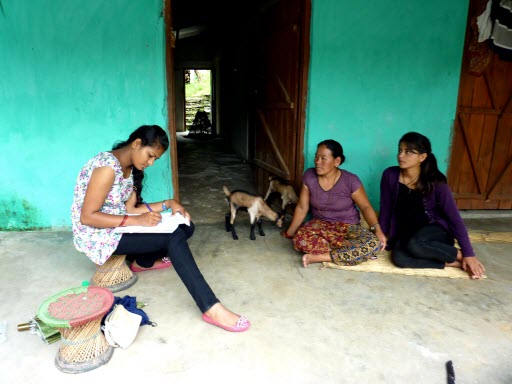
Household Consumption Survey of Rural Nepal 2000-2001, First Round
Nepal, 2000 - 2001
Central Bureau of Statistics
Created on July 19, 2017
Last modified July 19, 2017
Page views 120390
Download 21520
Documentation in PDF
Metadata
DDI/XML
JSON
Household (hh)
Data file: roster
Overview
Valid:
0
Invalid:
0
Type:
Discrete
Decimal:
0
Width:
2
Range:
1 - 12
Format:
Numeric
Questions and instructions
var_qstn_ivuinstr
There are some exceptions to this rule, which are described below:
1. The following categories of persons are treated as household members even though they have
lived less than six months in the household during past 12 months:
(I) infants who are less than 6 months old,
(ii) a newly married couple who have been living together for less than 6 months, and
(iii) persons living together for less than 6 months but who are expected to live in the household
permanently (or for long duration).
2. Lodgers or other permanent residents who live and take their meals with the household are to becounted as household members, even though they may have no blood relationship with the householdhead.
3. Servants or other paid domestic employees should be counted as part of the household.
4. People who have lived in the household for more than six months of the past 12 months but have
permanently left the household (e.g. separated or dead) are not considered members of the household for
our purposes.
People who live in the same dwelling, but do not share food expenses or do not eat meals together, are
not members of the same household. For example, if two brothers, each having his own family, live in the
same house but maintains separate food budgets and cooking facilities, they would constitute two
separate households. Likewise, people who eat together but do not live in the same dwelling are not
members of the same household.
It is very important that you define the household membership strictly according to the criteria outlined
above. These guidelines may not be the same as others you may be familiar with, and at times, they may
not conform to the household’s own notion of who should be considered as a household member. Any
questions or doubts that arise in the field should be discussed with your supervisor.
1. The following categories of persons are treated as household members even though they have
lived less than six months in the household during past 12 months:
(I) infants who are less than 6 months old,
(ii) a newly married couple who have been living together for less than 6 months, and
(iii) persons living together for less than 6 months but who are expected to live in the household
permanently (or for long duration).
2. Lodgers or other permanent residents who live and take their meals with the household are to becounted as household members, even though they may have no blood relationship with the householdhead.
3. Servants or other paid domestic employees should be counted as part of the household.
4. People who have lived in the household for more than six months of the past 12 months but have
permanently left the household (e.g. separated or dead) are not considered members of the household for
our purposes.
People who live in the same dwelling, but do not share food expenses or do not eat meals together, are
not members of the same household. For example, if two brothers, each having his own family, live in the
same house but maintains separate food budgets and cooking facilities, they would constitute two
separate households. Likewise, people who eat together but do not live in the same dwelling are not
members of the same household.
It is very important that you define the household membership strictly according to the criteria outlined
above. These guidelines may not be the same as others you may be familiar with, and at times, they may
not conform to the household’s own notion of who should be considered as a household member. Any
questions or doubts that arise in the field should be discussed with your supervisor.
Description
Definition
A household is a group of people who normally live together and eat their meals together.
Universe
All rural households